Add the great family time to witnessing the rescue of 33 miners and it made for a fantastic week. It was so amazing to see the unity of the country and all of the effort put into saving human lives. It really made us proud of Chile and doubly proud, listening to the miners' testimonies after the event. Last night, when an interviewer asked the miners about the experience of having a Bolivian trapped underground with them, one of the miners commented, "It's time to leave aside our pride and politics, so that we can see each other as human beings." There is generally a lot of tension (and a good deal of racism) between Chileans and Bolivians, so it was touching to hear him make such a wise statement. The whole experience has been a powerful testimony to the world that God is here with us always and that we should never lose hope. One of our Columban priests here in Chile had the opportunity to visit "Camp Hope" before the miners were rescued. It's definitely worth checking out his article: "Trapped: Faith Helps Families of Miners."
Showing posts with label Chile. Show all posts
Showing posts with label Chile. Show all posts
October 17, 2010
A Good Week
We finished up Family Week on Friday, with a celebratory spaghetti dinner. Spaghetti is known as the Poor Man's Meal here, so people were kind of disappointed to hear the menu. But, after tasting David's super sauce, the complaints stopped and plates showed up for seconds. And thirds. Sometimes in parish life, petty differences and jealousy create lots of division. So, it was nice to see the community come together and just enjoy each other.

September 20, 2010
Our Last Dieciocho
We celebrated Chile's 200th year of Independence this weekend, and also our last Independence Day here on mission. We decided a short time ago that we would be going back home to the States this January. So, the word has been getting out slowly to our friends and neighbors. We spent the festivities visiting with different families in the community. We ate and drank well with chicha, Chilean wine, empanadas, and lots and lots of meat! Vegetarians don't do well in Chile. We're still celebrating actually, and planning another outing tonight, but are giving our stomachs a chance to rest a little before we head to the next party.


We dressed Joshua in a traditional Aymaran outfit, from the north of Chile. The harmonica isn't exactly part of the outfit, but he wouldn't let go of it all weekend.

In front of the flag, he continues his harmonica concert.

Joshua had a great time playing with all of the kids at our neighbor's house on Saturday.

Anna dressed up too, in a "Huasa" outfit, or a traditional country style dress. The dog didn't want to dress up, but did agree to pose pretty for this photo.
September 15, 2010
Online Chat... the Results
The online chat thing turned out pretty well. We were afraid that no one would be interested in asking us questions, so we planted our family in the audience. The thing is, we forgot how huge our family is. So, even though just a fraction of our siblings and our parents showed up, they really stole the show. You can read the conversation here. It's especially helpful for people thinking about overseas mission:
March 8, 2010
Experiences After the Earthquake (English Version)
The following note was written by Alvaro Martinez, Vice-Director of the Region of Chile
Experiences after visiting places affected by the earthquake and tsunami
On Thursday, March 4th, I started my journey with three others - Eduardo, the camera man; Francisca, a journalist for t.v. station UCVTV and Fernando, my brother-in-law who also took photos. Our destination was Pencahue, located in the seventh region of Chile. Inicially, our motive was to bring help to those stuck in the town and to visit my sister who has suffered the complete loss of her house. But, God along with technological possibilities had some additional desires. This was the way that the idea arose to document the damage caused by the earthquake. Even though the original destination was the small town Pencahue, the massive destruction we found caused us to visit more places, such as Pencahue, botalcura, corinto, Curepto, iloca, hualañe and sagrada familia.
The massive destruction of homes, jobs, hopes and dreams mixed together with hopes and dreams of lifting up out of this tragedy. Communities such as Pencahue have lost around one thousand houses, only a parcial count that has been turned in by the local authorities. More than 60% of Curepto was destroyed. The massive damage and destruction in Corinto and botalcura were mainly due to the earthquake, while in iloca, it was not hit only by the quake, but also struck by the tsunami.
There were so many accounts to be told and heard. People slept outside of their houses due to fear, or simply because they had no where to live. We saw babies sleeping in the street and elderly people crying while looking to their faith, trying to find the reasons why an earthquake of such magnitude would occur here. Some of the stories were so emotionally moving that even though the victims held back their tears, it made the heart cry. One such story was when a woman came up to us and said, "I don't want help. Thanks be to God, I am alive and I have what I need to survive. What I really need is for someone to listen to me." How can one not break down, when faced with women fighting over a ration of food, or men and women broken from the weight of the walls that fell upon them. Hearing the screams of children saying, "Hear we are! And we need help too."
I could write a thousand more stories, describing the thousand more faces, or the reuniting of a father and son in Iloca. We picked up this father on the highway and acompanyed him during tense moments looking, asking, demanding to know where his son was, where he was staying, who was caring for him. We finally found the house and they were able to reunite. We witnessed the encounter and the embraces of those that perhaps, we will never meet again. Even so, we will never forget those moments of looking and encounter.
Finally. The earthquake has passed and the sea has returned to its normal rhythm, but today we are able to visualize the first human replicas of the disaster. The post earthquake traumas are now appearing. They are surfacing in the fear of noises, the physical effects of exhaustion, the peoples' inability to tell and retell their experiences. This displays itself through physical signs. The material need is urgent, but we shouldn't forget about these other dimensions of human life. It is necessary to speak and hear the words unspoken and the stories not told. The reconstruction of this country will not only deal with houses, but also with morality. We cannot negate the looting or pretend that it didn't happen. The spiritual and psychological world has also been harmed and need to be repaired.
The truth is that words cannot express what we have felt and lived through. At the end of the more than 1,000 kilometers traveled, Fernando referred to what we have experienced as being stronger than what was shown on television. It was definitely more raw, but I think that the reason is that the television can't transmit the smells or the dreams and stories shared over a cup of tea or a sopaipilla. I think that we went through this experience so that we could touch the wounds of Christ and feel as if we were with Him, the pain of feeling abandoned by His Father, who exclaims, "My God, my God, why have you forsaken me?." Without a doubt, we were touched by those moments that we were able to share with the Christs of today, but we were also able to share the hopeful words of Jesus, "Father, into your hands, I commend my spirit." As an elderly woman said, "God has given me this experience and I was able to live it with Him."
Alvaro Martinez.
Experiencias Después del Terremoto
Lo siguiente fue escrito por el P. Alvaro Martinez, el vicedirector de los Columbanos en Chile:
Experiencias después de visitar lugares del terremoto y tsunami
El jueves 4 de marzo partimos cuatro personas, Eduardo, camarógrafo, Francisca periodista del canal de televisión UCVTV, y Fernando, mi cuñado que hizo de fotógrafo. El destino fue Pencahue, localidad de la séptima región de Chile. Inicialmente el motivo fue llevar ayuda para los damnificados y visitar a mi hermana que ha sufrido perdida total de su casa . Pero Dios y las posibilidades tecnológicas quisieron agregar otros deseos. Fue como así surgió la idea de documentar el daño producido por el terremoto. Aunque el destino inicial era el pueblote Pencahue, lo masivo de la destrucción nos motivo a visitar mas lugares, algunos de ellos son: Pencahue, botalcura, corinto, Curepto, iloca, hualañe, sagrada familia, entre otros.
La destrucción masiva de hogares, empleos, sueños y esperanzas se entremezclan con sueños y deseos de levantarse. Comunidades como Pencahue que ha perdido cerca de mil casas, cifras parciales entregadas por la autoridad local. Curepto mas del sesenta por ciento destruido. Corinto, botalcura masivamente destruidos y dañados por el efecto del terremoto e iloca que no solo el terremoto sino que también fue azotado por el tsunami.
Las historias escuchadas y contadas son tantas , la gente dormía fuera de sus casas por temor, o simplemente porque ya no tiene donde vivir. Vimos bebes durmiendo en la calle , gente adulta mayor llorando y tratando de explicar por medio de la fe lo que les había producido este sismo de tan altas dimensiones. Algunas de las historias movieron tanto el corazón que algunos de los integrantes contenían las lagrimas, sin embargo, el corazón lloraba, como no cuando una mujer se nos acerca y dice “ yo no quiero ayuda , gracias a Dios estoy viva y algo tengo para sobrevivir lo que necesito es que me escuchen” como no quebrarse frente a la historia de mujeres peleándose a golpes por una ración de comida, o mujeres y hombres rotos por los golpes de las murallas que caían encima de ellos. Gritos de niños que dicen aquí también necesitamos ayuda.
Podría contarles mil historias mas, describir mil rostros mas, o el reencuentro de un padre con su hijo en Iloca. A este padre que llevamos desde la carretera y lo acompañamos durante tensos minutos buscando, preguntando, clamando donde esta el hijo, donde esta quedándose, quien lo esta cuidando, finalmente encontramos la casa y se pudieron juntar, reencontrase y empezar los abrazos de estos dos personas que quizás nunca los volvamos a ver. Sin embargo, esos minutos de búsqueda y el reencuentro jamás se nos olvidaran.
Finalmente. El terremoto ha pasado y el mar ha vuelto a su ritmo normal. Pero hoy se empiezan a visualizar los primeros replicas humanas del fuerte sismo. Es decir, los traumas post terremoto están apareciendo , están apareciendo los miedos a los ruidos, los efectos físicos del cansancio, la incapacidad de contar y recontar el momento vivido por las personas en estas localidades, eso empieza a salir a través de signos físicos , lo material es urgente pero no nos olvidemos de esta otras dimensiones del la vida humana, las palabras no dichas y las experiencias no contadas, son necesarias decirlas y escucharlas. La reconstrucción de este país no es solo casas, también es moral, no podemos negar los saqueos o pretender que no pasaron, el mundo espiritual y sicológico también están dañados y necesitan ser reconstruidos.
La verdad es que las palabras no pueden expresar lo que hemos sentido y vivido. Al final de los mas de mil kilómetros recorridos, Fernando hace la referencia a lo que hemos vivido es aún mas fuerte de lo mostrado en televisión. Si era mas crudo, pero creo que la respuesta se traduce en: la televisión no puede transmitir los olores, los sueños e historia contadas al calor de un mate o sopaipilla compartida. Creo que si eso nos pasó es que pudimos tocar las llagas de Cristo y sentir con él, la pena de sentirse abandonado por su Padre, estos son los cristos que claman Dios, mío Dios mío porque me has abandonado. Sin duda, nos dejo tocar ese momento y compartirlo con los Cristos de hoy pero también pudimos compartir las palabras de esperanza de Jesús , en tus manos encomiendo mi espíritu. Como dijo una anciana Dios me ha dado esta experiencia y pude vivirla con Él.
Alvaro Martinez.
March 3, 2010
Act of God?
Watching the news and hearing people's personal experiences of the earthquake has given us something to think about. We can't help but make comparisons, as CNN has done, between Haiti and Chile. While this quake was 100 times more powerful than the one in Haiti, the devastation has obviously been much less. Over 200,000 were killed in Haiti; in Chile, the count is just over 800. Better infrastructure, preparedness and a very organized government reaction can be cited as reasons for Chile's less devastating outcome. But, we would like to point out something more general as the differentiating variable, and that is injustice.
With natural disasters, we often lament that nothing can be done, that it is an act of nature that can affect anyone. While true, the devastating consequences have much more to do with poverty than with randomness. Haiti is a poor country with a highly corrupt government. Chile is the most economically successful country in Latin America and prides itself on very little corruption. Personally, we think the difference in consequences has more to do with apathy than with God's will.
With natural disasters, we often lament that nothing can be done, that it is an act of nature that can affect anyone. While true, the devastating consequences have much more to do with poverty than with randomness. Haiti is a poor country with a highly corrupt government. Chile is the most economically successful country in Latin America and prides itself on very little corruption. Personally, we think the difference in consequences has more to do with apathy than with God's will.
As US citizens living in another country, we are reminded daily that we are economically privileged. Jesus clearly teaches that believers with wealth have a great task ahead of them, "Again I tell you, it is easier for a camel to go through the eye of a needle than for a rich man to enter the kingdom of God." (Matthew 19:24). We have a moral responsibility to use our wealth wisely, to fight injustice and together with all Christians, to help build God's kingdom here on earth. What happened in Haiti is proof that we're not doing our job.
Our apathetic attitudes towards our neighbors in destitute situations has its consequences. We saw the same thing during Hurricane Katrina. Those who suffered most were the poor and marginalized. No one can prevent natural disasters, but we are capable of lessening their negative impact. The fact that Haiti suffered so much more than Chile is a result of our sinfullness and should serve as a reflection during this lenten season... Are we personally responsible in some way for the suffering of others? If so, how can we work to create a more just world?
March 1, 2010
Personal Accounts
We received these two reports from Columban priests working in Valparaíso and Santiago this morning. We are so thankful that we had no major injuries or damages in the Columban family.
- - - - - - - - - - - - - - - - - - - - - - - - -
Earthquake in Chile
(report by Fr. Derry Healy, the director of the Columbans here in Chile)
We are all well and alive, just the shock of the whole experience. All the Columban group are safe and haven´t suffered major damages. Most of the contents of the houses were turned over with the shake. I was not long in bed and was woken up to what I thought was someone trying to break it as the woodwork creaked and the front door vibrated. Soon I felt the whole house shaking and I just and ran for it and up on to the street. Our house is wooden and on stilts on the edge of a ravine. I felt like it was never going to end. Many of us spent the rest of the night on the street with the people. Here in Valparaiso, we gathered the people around, clear of building and electricity wires and got a fire going and made a 40 litre pot of tea. Luckily we has a supply of cups in the Ecological Centre.
I managed to contact all the Columbans (lay missionaries, Associates, Sisters and priests) by yesterday afternoon. Mobile phones were the first to get back the signal. he Centre House in Santiago has suffered minor damages. Also some of our chinches presnet some cracks, but nothing major. Communications, water and electricity are being gradually restored. Since the last major earthquake on March 3rd 1985, strict anti-sismic building regulations have been put in place in Chile and this has prevented a major disaster. This earthquake was much stonger than any experienced in rcent years.
Yesterday, Saturday, was like a "Holy Saturday" just contemplating suffering and vulnerability and in a limbo situation. Today Sunday the gospel of the the tranfiguration gives us new hope and wonder and while the little Christian community would like o stay on Mount Tabor, they are now chllenged to become envolved in the wider community and keep hope alive amid so much disaster. Today there has been here movement and people are trying to get to normal. There are still some tremors as I write this. People around here are still on the street and won´t go back into their apartments yet.
Derry.
- - - - - - - - - - - - - - - - - - - - - - - - -
Report by Fr. Dan Harding, an Australian Columban working in Santiago
This earthquake at 8.8 at the epicentre on the Richter Scale was one of the most powerful in history, or rather since recording earthquakes began. It was the fifth most powerful earthquake ever recorded in history and lasted almost 3 minutes. Even though the city of Santiago is several hundred kilometres from the epicentre, the level of intensity for us here in Santiago was 8.5 on the Richter scale. Remember the Haiti earthquake was 7.0 on the Richter Scale. The largest earthquake ever recorded was in Chile in 1960 at 9.5 on the Richter scale. Speaking personally it was a terrible shock to be awoken from deep sleep at the beginning of the earthquake. I was awoken by my small dog barking and birds outside fluttering wildly. I thought to myself that a neighbours' cat must be at the birds. So I got up and turned the light on. Just then the earthquake started in great intensity and all the electricity cut out. I was lucky to get outside and hold on to a fence in the darkness as the earth, trees and buildings around me shook wildly. It was an extremely frightening experience. One is completely helpless, not knowing what is going to happen and trying to catch one's breath. Luckily none of us in the Columban Centre House were hurt and there was only minor damage to the buildings. After an earthquake everyone goes out onto the street for fear of after shocks. I spent the rest of night with hundreds of neighbours out on the footpath in pajamas in the cold morning air. Much of the central part of Chile with over 80% of the population has been badly affected by the earthquake and the following Tsunami along the coast. Over 2,000,000 people have had their homes damaged or badly affected. Since the earthquake at 03.34 am Saturday morning local time, we have received over 90 after shocks which will continue for months ahead. Some of the after shocks like one at 8.30 this morning (Sunday) were in themselves small earthquake at 6.5 on the Richter Scale. The death toll is at 708 and climbing with dozens of disappeared. The epicentre of the earthquake was only 90 kilometres from the city of Concepción, which is 500 kilometres from Santiago to the south along the coast. We Columbans do not work in Concepcion. There has been massive damage to Concepcion, its twin city Talcahuano and other cities between Santiago and Concepcion such as Chillan, Talca, Linares and Rancagua. In Concepcion, a 14 story apartment block fell over backwards and snapping into various parts. Rescue teams are still working on this building with over 40 people still unaccounted for. Continuous after shocks hinder the rescue work. Today Sunday, police and now the military are trying to hold back looters in Concepcion and Santiago from looting supermarkets, shops, banks etc. Few supermarkets are open here in Santiago today for fear of looters. The metro is not yet functioning. There is a sense of panic in the air with large lines at petrol stations and the few shops open. This afternoon when I had to travel through the older part of Santiago, I saw hundreds on buildings damaged, burst water mains and families with a few pieces of furniture living out on the footpaths. The Terminal at the International Airport in Santiago was severly damaged and only now are a few flights arriving from overseas. People wanting to leave Chile have to travel over the Andes to the Argentinian city of Mendoza and from there fly to Buenos Aires. In the city of Chillan, south of Santiago, a wall in the local jail collapsed and over 200 prisoners escaped. The earthquake at 03.34 am Saturday morning, was followed 20 minutes later by a Tsunami along the Chilean coast up as north as Valparaiso, which is on the coast near Santiago. Giant Tsunami waves entered the coastal cities of Talcahuano, Constitucion and many coastal resort towns such as Ilorca, Duao and on the island of Juan Fernandez, washing out to sea hundred of house, buses, cars and people. As Chileans are used to earthquakes and Tsunamis, many people from the coast managed to escape to higher ground before the arrival of the Tsunami. At this stage, it is not know how many people were drowned by the Tsunami, but it is estimated that at least 150 people were drowned in the city of Constitution alone. In one coastal town, a Ferris Wheel was dragged upright from a small fair by the Tsunami wave a distance of 250 metres. It is Sunday night here as I write this email. Hundred of families are sleeping outdoor in Santiago alone because their homes have either been destroyed or seriously damaged and are dangerous to occupy. Most damage in Santiago is in the older colonial part of the city. In this area, there are families sleeping in all the parks, plazas and outside their damaged apartment buildings. Many beautiful old colonial style churches have been damaged or destroyed. All around Santiago and on the main highway to the south, overpasses have collapsed effectively destroying much of Chile's advanced highway system. Thousands of people in Santiago as well as in the south do not yet have electricity or water connected. We Columbans have asked the people in our parishes to pray and to help as much as possible the victims of the earthquake and the Tsunami. We will most likely be organizing special masses and collections and fund raising activities in all of our parishes. Chile is one of the most organized countries in South America and especially well prepared for earthquakes and tsunamis. All schools have earthquake practice and for those near the coast, tsunami practice. Chilean rescue teams played an important role recently in Haiti. In less than two weeks, we will have a change of government which will complicate somewhat the recovery efforts. Please keep the Chilean people in your prayers and we Columbans serving here. We thank God that none of us were hurt in any way.
Blessings, DAN HARDING
February 28, 2010
Big Events
The big news this week is the huge earthquake in Chile. While we were not affected here in the north, many of our friends and coworkers were badly shaken. The latest news is more than 700 deaths and tons of structural damage from the center to the south of the country. Many are without electricity or water. People are looting the supermarkets for food, water and some not-as-necessary items (big screen plasma t.v. anyone?). As far as our Columban family, we haven't had any injuries or deaths. We are again reminded to thank God for each day of life and to live that day to the fullest.


The earthquake came just a couple days after we arrived back home from a trip to Bolivia. We spent a week and a half in Cochabamba, where we studied Spanish five years ago, in the beginning of our mission. Bolivia is a beautiful country with an amazing and lively culture. It was great to go back and speak with our Bolivian family, much more fluently and to get reacquainted with the culture we fell in love with back then. Our timing couldn't have been better, as we arrived the weekend before lent and got to experience the Carnaval festivities.
Sadly, this was also our last week with Anna's sister Joanna. She has been in Chile for the last nine months and it's been great to have family so close. Joshua will really miss his tía and so will we. She was supposed to fly out of Santiago on March 2nd, but the airport is closed due to the earthquake. So, after a full day of running around the city and international calls, she arranged to travel by bus to Lima, Peru and to fly out of there to Miami. What a week! Here are some photos of the more pleasant times:
Us with our Bolivian family five years ago.
Us with our Bolivian family a couple of weeks ago. The girl on the left is a current student at the language institute and is living with our Bolivian family while she studies.
"Cristo de la Concordia" overlooks Cochabamba. Cochabambinos claim that this is the largest image of Christ in the world... bigger than the one in Brazil. This is a dispute that only Wikipedia can resolve.

Our Bolivian mom's hometown "Tarata." Her aunt continues to live and farm here. These are her very thirsty wheat fields. During the week of Carnaval, Bolivians take the opportunity to ch'llar, or bless, their homes and work places. They invited us with them to ch'llar the wheat fields. It was a very interesting experience!

The front door to their house in Tarata, a very colonial town. The two women in front are neighbors and show the typical Bolivian dress.
Joshua with a friendly baby alpaca!
Our Bolivian mother takes great joy in embarrassing us whenever she can. This time, she dressed us up in polleras (typical skirts) and had us dance in the street during Carnaval. It was a lot of fun, but she forgot to mention to us before hand that the dancers get soaked by the spectators with water guns, shaving cream and water balloons.
These two men are dressed for the "Tinkus," a really interesting dance that we got to perform at language school five years ago.
Our version of the "tinkus" looked something like this.
January 11, 2010
Sex Ed
We spent 9 hours listening to lectures today. We plan on doing the same thing tomorrow, the next day and every day this week. While we didn't really enjoy the sitting so long part, we are very thankful for the chance to learn a little more about a topic that has us frustrated to no end here on our mission. We're taking a course in Santiago called "Teenstar" that is capacitating us to teach comprehensive, faith-based sex education to teens.
"Sex Ed Teacher" isn't exactly the job title we were looking for when we signed on to come to Chile, but through working with the youth here, it became apparent very early on that the kids needed something more. We learned today that in 2008, 15% of the babies born in Chile were born to teens. And from personal experience, we know that a much higher rate would be found in the neighborhoods where we live and work - poor, underprivileged and poorly educated areas. For example, at the last Confirmation we attended in the parish where we used to work in Santiago, of the 40 teens getting confirmed, 3 were pregnant and at least one already had a baby. Another youth from the group recently found out he has HIV. While we do our best to accompany them and try to guide them on a path to good decision making, it's obvious that we need help.
While we're struggling with teen libidos, Joshua is endeavoring on a new adventure... he spent the whole day with a babysitter for the first time. Anna cut out of class early because she couldn't stand the separation any longer, rushing home to find Joshua contently playing at the babysitter's house and not too anxious to come home. It hurt our feelings that the little guy could actually have a good time without us, but we're happy that he adjusted so well. We'll see how he is after a week.
January 1, 2010
Things Chileans Do...
... at midnight on New Year's Eve:
2. Eat 12 grapes to guarantee 12 lucky months.
3. Wear yellow underwear to have luck in love.
4. Create life sized dummies out of old clothes and newspaper and burn them to get rid of the bad vibes from last year and create good vibes for the new year.
5. Hug and kiss everyone in the neighborhood, wishing them a great year.


December 31, 2009
The Christmas Shuffle
We arrived back in Chile unmentionably early on the 16th. David got smart and decided to black out Joshua's windows with blankets, hoping to trick him into sleeping longer. His plan unfolded flawlessly and we awoke at 2pm, a well-rested and happy-to-be-home family. We quickly realized that there was no food nor Christmas cheer in the house, and we only had one week to prepare. So, we spent the week before Christmas buying a tree, making paper stockings, baking and listening to carols in an attempt to make it "feel" like Christmas. We especially wanted to make it nice this year for Anna's sister Joanna, who was spending her very first Christmas away from home and with us. Plus, Joshua actually seeming to picking up that something different was floating in the air.



We gifted banana bread and cut out cookies this year, making sure to add a diabetic version of both. (Based on no factual statistics, we would guess that Chile has the highest rate of diabetes of any country.) We really enjoyed taking the plates of treats to our neighbors' houses, which gave us a great excuse to visit and see how things were going with each one. We were reminded that the best mission work is done just by being a friend and visiting wit
h families. We wished that we had taken more time to talk with each one throughout the year, and focused less on meetings, activities and administration. Perhaps a New Year's resolution in the making...
We attended "midnight" mass at 9pm. With a shortage of priests and four communities to serve, not every chapel can have a mass at midnight. After mass, we shared hot chocolate and "pan de pascua," a type of fruitcake, with the community. We then had Christmas eve dinner at a neighbor's house. This family is originally from Ecuador and understood
what it's like to be far from home during the holidays. Joshua loved playing with their two 6 year old cousins and rearranging their furniture, a hobby that he's picked up recently. Santa Claus arrives at midnight in Chile and the children open their presents after dinner, then run to the streets to play with their new toys. We walked home around 1 am to a chorus of laughing children and fire crackers. We decided to wait until morning for our presents.
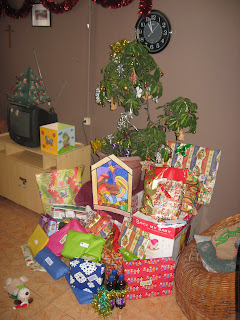
On Christmas morning, we awoke to find that Santa had not passed us by, although we did fear finding coal in a couple of stockings. Joshua smiled and giggled at each new gift and absolutely loved every. single. one. Including the socks and undershirts. We did, however, find our gift to him, a picture Bible, still wrapped in the trash can, two days later. Apparently, he thought it was really fun to throw wrapping paper into the can, and the fact that the paper was concealing a gift didn't really matter that much to him.
We continued celebrating until just recently, when we realized that yet another holiday is upon us. We are now preparing for New Year's, where we'll spend the night celebrating with another neighbor family. We'll let you know how Joshua likes staying up past midnight and eating a bunch of junk food yet again.

September 21, 2009
Happy Birthday Chile
The 18th of September was Chile's 199th birthday. In our chapel, we decided to celebrate big, with a traditional fonda or carnival type of party. We had all the fixings for a fun family day -traditional dancing, foods and lots of games, including rayuela, a game typically played in the country, sort of like horseshoes. The only thing missing was chicha and red wine. It's almost unheard of to have a fonda with no alcohol, but the community decided that in order to make it truly family friendly, they could do without the drinking and fighting that often overrun independence day parties these days.

Fondas are traditionally decorated with large palms.

Fr. Mike Howe, the Columban priest in charge of the chapel starts us off with a blessing.

The teenagers ran the games. They worked hard the whole six hours without taking a break.

Chile's national dance, the Cueca, performed by local school children.

The kids also showed us a traditional Mapuche dance, from the south of Chile.

Meat, meat, meat! Chileans are not inclined to vegetarianism.

The northern version of the cueca.

Anna's sister is here visiting until March, and dressed up for her first Dieciocho celebration.

The rayuela competition was a big hit... David almost won.

It was great to see so many families participating, including dads.

The guitar is the unofficial national instrument. No party is complete without a song.

Our gringo Chilean family portrait.

Unfortunately, the fun was interrupted by a fire in the neighborhod. Two families lost their homes. Please keep them in your prayers.
July 15, 2009
La Tirana
It's Tirana time in northern Chile... and oh, what a time it is. "La Tirana" is actually the name of a local village where a large religious festival takes place each year in celebration of Our Lady of Mt. Carmel. The big draw is that tons (as in hundreds) of dance groups come into this tiny little town, complete with ornate costumes, and dance in honor of the Virgin for ten days (NON-stop). It's controversial, even among Catholics, due to the non-Christian beginnings of the festival, its commercialization and the confusion between honoring and worshiping saints. Both sides have some really valid points, but we personally lean more towards loving it. It's a lot of fun, the dancing and the colors are enlivening and peoples' faith in God seems to grow and flourish throughout the festivities. Some images from last year:


Sadly, the festival was officially cancelled this year due to the swine flu, but a much smaller version is taking place throughout Iquique and Alto Hospicio. Our parish has the privilege of hosting all of Alto Hospicio in the mini-festivities. So, we'll get up pictures and commentaries later on this week.
Subscribe to:
Posts (Atom)